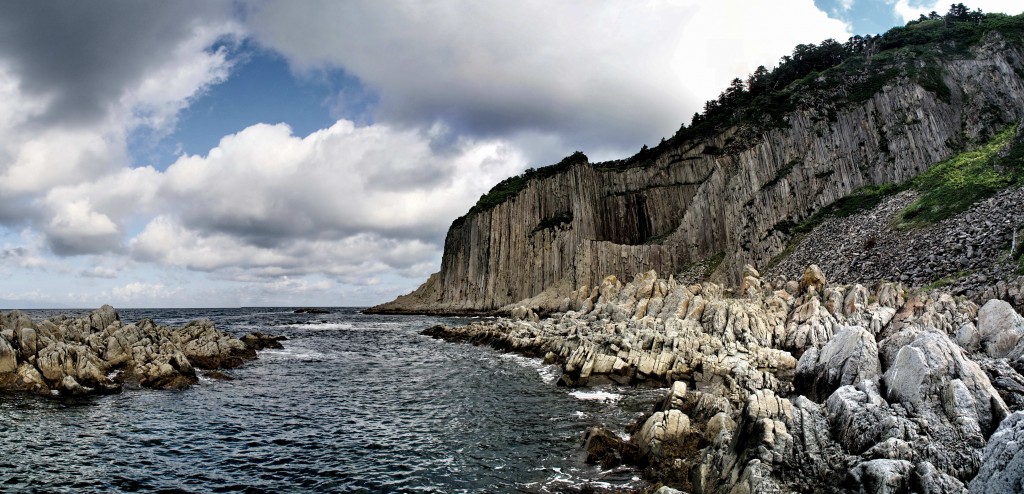
“Stolbchaty cape, Kunashir Island”, taken by Dmitry Demezhko. This image is distributed by the European Geosciences Union under a Creative Commons licence.
The Kuril Island Chain is formed by four active volcanoes: Golovnin, Mendeleev, Tyatya and Smirnov. Stolbchaty Cape, where the Okhotsk Sea meets the coast of Kunashir Island, is not far from Mendeleev Volcano – responsible for the many hot springs in the area. These are fed by seawater and heated as the water comes into contact with magma and hot rocks within the mantle.
The picture shows an outcrop of columnar jointed andesite prisms. Andesite is a silica-rich volcanic rock and the columnar jointing results from the rapid cooling of erupted lava. Rapid cooling puts the lava under stress as it contracts and causes it to fracture perpendicular to the cooling surface.
Generally, the top of a lava flow is the coolest part because there is greater heat loss from the surface of the lava flow, but to induce fracturing, the erupting lava must meet an extremely cold surface. Air is insufficient to cause such rapid cooling and the presence of these prismatic columns indicate that the eruption occurred under ice.
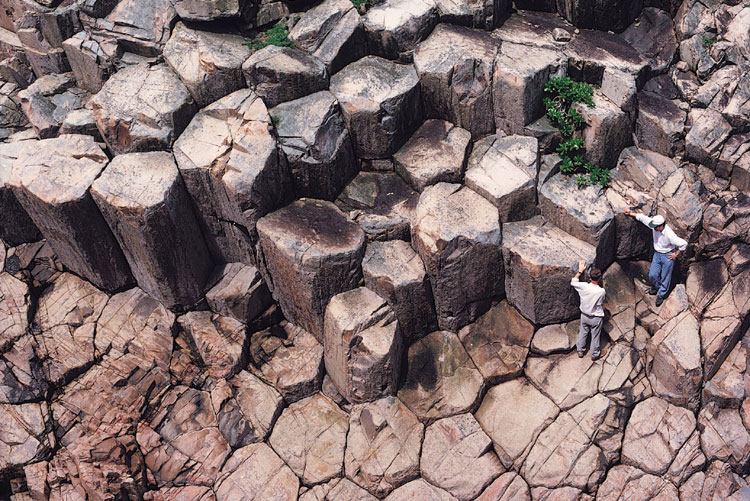
Columnar jointing within a caldera-fill ignimbrite in the High Island formation, with some Geologists for scale [Source: CEDD, Hong Kong]
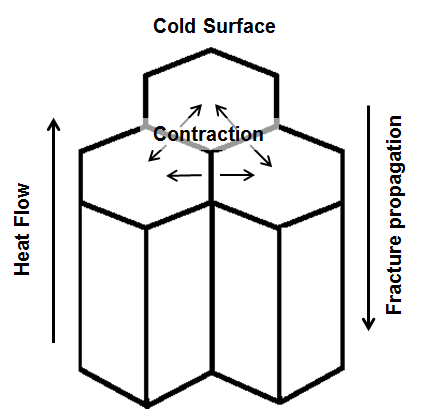
Processes leading to columnar jointing in igneous rocks.
The photographer, Dmitry Demezhko, was not here to look at the jointing though; in fact he is a geophysicist, investigating the thermal field of the Earth. During the last five years he has conducted continuous temperature monitoring in a borehole here with the aim to investigate the origin of temperature variation associated with seismo-tectonic events in the Kuril-Kamchatka region.
Imaggeo is the EGU’s online open access geosciences image repository. All geoscientists (and others) can submit their images to this repository and since it is open access, these photos can be used by scientists for their presentations or publications as well as by the press and public for educational purposes and otherwise. If you submit your images to Imaggeo, you retain full rights of use, since they are licensed and distributed by the EGU under a Creative Commons licence.