Archive | Planetary and Solar System Sciences RSS feed for this section

Imaggeo on Mondays: Spying on the Arctic

6 May

This week’s Imaggeo on Mondays is brought to you by the photographer himself, Fabien Darrouzet who captured the beautiful glacial landscape during a summer expedition to the Arctic. 

“Arctic through a porthole” by Fabien Darrouzet, distributed by the EGU under a Creative Commons Licence.

This picture was taken in Svalbard (78° lat.) in June 2012. I was there for one week in order to observe the transit of the planet Venus in front of the Sun. I came here because at this time of the year, the Sun is shining all day (midnight Sun), so it was possible to see Venus during most of the transit (for over six and a half hours!), and not only during its last minutes, as was the case for most parts of Europe.

During the days before the transit, I made a boat trip inside the fjords around Longyearbyen, and in particular in the Isfjorden, where I took this picture through the porthole of the boat. This is the southern border of a territory of Svalbard named Oscar II Land. This area, and indeed all of Svalbard, is covered by snow most of the time, and just a few plants can germinate during July-August, when the average temperature is 5°C.

Svalbard is a very important island and region because it is dominated  by glaciers (60% of all the surface), which are important indicators of global warming and can reveal possible answers as to what the climate was like up to several hundred thousand years ago. Those glaciers are studied and analysed by scientists in order to better observe and understand the consequences of the global warming on our Earth.

By Fabien Darrouzet, Belgian Institute for Space Aeronomy

Imaggeo is the EGU’s online open access geosciences image repository. All geoscientists (and others) can submit their images to this repository and since it is open access, these photos can be used by scientists for their presentations or publications as well as by the press and public for educational purposes and otherwise. If you submit your images to Imaggeo, you retain full rights of use, since they are licensed and distributed by EGU under a Creative Commons licence.

Geotalk: Alexis Rouillard

19 Apr

Geotalk is a regular feature highlighting early career researchers and their work. Following the EGU General Assembly, we spoke to Alexis Rouillard, an Arne Richter Outstanding Young Scientist awardee and a brilliant space scientist.

First, could you introduce yourself and let us know a bit about your current work at the French National Centre for Scientific Research?

Hi, I am Alexis Rouillard and I currently work as a permanent researcher at the CNRS, where I investigate heliospheric physics. My research focuses on the physics underlying several phenomena occurring in the vicinity of the Sun, the interplanetary medium and the near-Earth environment. I graduated in 2002 with a Master’s degree in Physics with Mathematics from the University of Southampton and obtained a PhD in Physics and Astronomy in 2007 from the same school. After a three-year postdoc at the Rutherford Appleton Laboratory in the UK and at the University of Southampton, I took the position of Research Associate Professor at George Mason University, Virginia, USA, working at both the Naval Research Laboratory and NASA Goddard Space Flight Center. A little over a year ago, I joined the Institut de Recherche en Astrophysique et Planétologie (CNRS) in Toulouse. This training has exposed me to a wide range of instrumentation and ways of doing research in space physics. I was very fortunate to work with many researchers with very different approaches to solving science questions.

During the EGU General Assembly, you received an Arne Richter Award for Outstanding Young Scientists for your innovative studies in the planetary and space sciences. Could you summarise the research you have done in this area?

My thesis was focused on the origin and effect of some solar wind structures called corotating interaction regions. They form between the Sun and 1AU when fast solar wind is brought into radial alignment with the slow solar wind due to solar rotation. The fast solar wind catches up with the slow solar wind and creates an area of high density (a compression region) that can develop into shock waves.  These structures are a temporary barrier to galactic cosmic rays propagating from the interstellar medium into the inner heliosphere, this was the topic of my PhD thesis.

I had just completed my PhD thesis when the Solar-Terrestrial Relations Observatory (STEREO) was launched by NASA (in 2006) with Heliospheric Imagers (HIs) on-board. These HIs provided the first high-resolution images of the solar wind electrons near 1 AU. The white light collected by the heliospheric imagers is photospheric light that is scattered by solar wind electrons. We could demonstrate for the first time that electrons compressed inside corotating interaction regions are systematically imaged by the STEREO HIs when they approach 1 AU (Rouillard et al. GRL, 2008) as well as a number of other phenomena described below.

The Solar-Terrestrial Relations Observatory (STEREO) – an artist’s impression. Source: NASA/JHU APL.

How do you image the impact of a solar disturbance on a planet and what can images like these tell us about near-Earth solar wind conditions?

Although STEREO was launched during an exceptionally quiet period of solar activity, major solar storms were occasionally launched from the Sun into interplanetary space, transporting large clouds of electrons. Since the STEREO HIs were imaging solar wind conditions near the Earth during the start of the mission, we could image several solar storms impacting our planet for the first time. The Earth is so small in these images that all we see is the storm passing over the location of the Earth, not the local deformation that occurs as the storm interacts with the Earth’s magnetic field. During the first three years of the STEREO mission, the orbital position of the spacecraft was perfect to determine the arrival time of a storm at Earth. This new instrumentation has become so useful that future space missions, particularly those dedicated to predicting near-Earth space weather, will have these imagers on-board.

You’ve had to master a huge array of techniques to complete work on solar energetic particles – what advice would you give other young scientists who need to balance their workload with taking time to learn new skills?

My advice is move out of your comfort zone and DARE! Don’t be afraid to plunge into new datasets.  Ask the simplest questions first, I’m always surprised to see how little is generally known in many areas.

During the exercise of research, I often find that many of my initial ideas or guesses, even though constructed on logical sequences of arguments turn out to be wrong after close inspection and a thorough test against a wide range of datasets. Nature is always ready to surprise us! Therefore, I tend to avoid areas of science where theories are too far ahead of observational or experimental capabilities – they tend to be stagnating areas of science.

When you start working with datasets that you are not yet familiar with, approach the most productive and creative scientists in your area of research. They never stopped being children and are usually genuinely interested in giving some advice to young scientists thereby often saving you a lot of time.

The Solar-Terrestrial Relations Observatory (STEREO) – an artist’s impression. Source: NASA.

Finally, what are your plans for the future?

I will carry on my research in heliospheric physics to prepare for the future major space missions: ESA’s Solar Orbiter and NASA’s Solar Probe+. Solar Probe +, ‘a NASA mission to touch the Sun’, will go the closest a probe has ever been to the Sun, right where the solar wind is accelerated (9 solar radii). This is very exciting; we will collect the data that is critical to understanding how the solar wind and energetic particles are accelerated to high energies.

ESA’s Solar Orbiter will return to the very inner heliosphere (0.3AU) and will image the solar surface and the solar corona from outside the ecliptic plane. This will provide critical information to answer a wide range of fundamental questions: where are solar magnetic fields generated? How are these magnetic fields expelled? How is energy deposited in the coronal plasma? We are also pushing for a new space mission located, like the STEREO mission, outside the Sun-Earth line to image transients propagating from the Sun to the Earth. Unlike STEREO the mission will remain at a fixed distance from the Earth and will be used by space-weather centres to accurately predict the onset and perhaps the magnitude of geomagnetic storms.

If you’d like to suggest a scientist for an interview, please contact Sara Mynott.

Geotalk: Dr Aikaterini Radioti

17 Oct

Geotalk, featuring short interviews with geoscientists about their research, continues this month with a Q&A with Dr Aikaterini Radioti (University of Liège) who tells us about her work on auroras in Jupiter and Saturn. If you’d like to suggest a scientist for an interview, please contact Bárbara Ferreira.

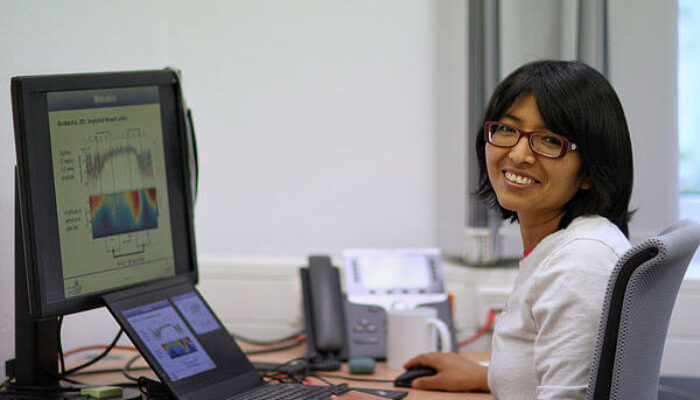
Dr Aikaterini Radioti at work

First, could you introduce yourself and let us know a bit about your current research activities?

I was born in Ptolemaida, Greece, in 1980. I studied Physics in the Aristotle University of Thessaloniki. I obtained my Ph.D. in Geophysics at the Max-Planck-Institute for Solar System Research (MPS) in Germany. During my Ph.D., I studied the magnetosphere of Jupiter by analyzing data from the Galileo spacecraft which was in orbit around the giant planet for eight years. After a short post-doc at MPS, I was offered a post-doctoral position in the Laboratory of Planetary and Atmospheric Physics at the University of Liège in Belgium, where I investigated the aurora at Jupiter and its relation to the Jovian magnetosphere. I combined remote auroral data from the Hubble Space Telescope with in-situ magnetospheric measurements in order to investigate the coupling between the ionosphere and the magnetosphere (ionospheric-magnetospheric coupling) at Jupiter. For the past three years, I have held a research associate position (Chargé de Recherches, FNRS) in the University of Liège. Recently, my research activities have been extended beyond Jupiter. I have started exploring the auroral emissions at another giant planet, Saturn, based on auroral data from the Ultraviolet Imaging Spectrograph (UVIS) on board of Cassini, a spacecraft which has been orbiting Saturn since 2004.

What can your work tell us about the magnetic field and atmosphere of the giant planets?

The investigation of planetary auroral emissions plays a key role in solar system research. The auroral activity is the visible signature of a long chain of interactions between a planet, its atmosphere, its moons and rings, the interplanetary space, and the Sun. Thus the study of the auroral emissions gives us a picture of the processes taking place in the magnetosphere, the magnetic field configuration, and the ionosphere. My research work focuses on the investigation of the ionospheric-magnetospheric coupling associated with certain processes taking place at the giant planets’ magnetospheres, such as corotation breakdown of the plasma (where layers of the magnetosphere do not all rotate at the same speed), magnetic reconnection, and plasma injections. By studying the auroral emissions related to the reconnection process and plasma injections, we learn about the frequency of the process, its origin and triggering mechanism, i.e., whether it is solar-wind or internally (mass-loading) driven. The auroral emissions related to corotation breakdown at Jupiter give us information about the plasma distribution in the magnetosphere at various local times, the influence of the solar wind on the magnetospheric convection, and the variations of the ionospheric conductivity. Finally, studying the auroral signatures of certain processes, in combination with the magnetospheric measurements, we can investigate the mechanisms that create auroral emissions (such as electron acceleration by field-aligned currents or electron scattering by whistler waves).

Earlier this year, you received an EGU Arne Richter Award for Outstanding Young Scientists for your “remarkable work in the field of auroral dynamics of Jupiter and Saturn”. Could you summarise the research you have done in this area?

My research focuses on the auroral dynamics of Jupiter and Saturn. For my scientific work I combined remote auroral and in-situ magnetospheric data, and I developed and applied theoretical approaches on ionospheric-magnetospheric coupling. I mainly studied the ionospheric signatures of magnetic reconnection, plasma injections, and corotation breakdown of the plasma. I showed that ejected plasma flow during magnetic reconnection in Jupiter’s tail couples with the ionosphere and creates periodic auroral emissions. At Saturn, magnetic reconnection in the flank of the magnetopause creates auroral emissions at the end of the ionospheric footprint of the newly opened magnetic field lines. By studying the auroral emissions associated with corotation breakdown, I demonstrated that solar wind-driven magnetospheric convection accounts for a regular discontinuity feature observed close to magnetic noon in the Jovian main auroral oval. Finally my research work suggested that energetic particle injections in the magnetosphere of Saturn could create transient aurora, through electron scattering or by electric currents flowing along the boundary of the injected cloud.

You have been involved in Europlanet, an EU project that lists outreach activities in the planetary sciences as one of its main goals. How important do you think it is for researchers to communicate their findings with the wider public?

In the framework of Europlanet, I contributed to the organization of three Europlanet workshops (2008, 2010, and 2012) under the financial support of the Europlanet NA1 and NA2 networking activities. We were a group of 30 participants, specialists on the auroral emissions at different wavelength and the associated magnetospheric processes. These workshops have been a great success and one of them was even included in the Europlanet Newsletter as a highlight of the 2010 year’s NA1 activities. Apart from supporting scientific communication between researchers, Europlanet promotes the communication of science to the wider public. Communicating science to the public plays a vital role for the researchers and science itself. Science outreach can help reverse negative attitudes and spark interest and enthusiasm. It creates awareness of the importance of research to the society and the community appreciates your profession and institution. As a result, the communities are encouraged to support science education. Scientists should not restrict themselves to sharing scientific information with their colleagues and publishing their work to scientific journals. Their scientific role does not end in their laboratories or classrooms. They should be educated and prepared for communication with a wider public. After all, they often seek financial support from the wider public for their research.

Last but not the least, what are your future research plans?

In the near future, I aim to continue working on the ionospheric-magnetospheric coupling and the auroral emissions. For the next couple of years my work will be focused on the auroral dynamics of Saturn, an area of research that has not been well investigated yet. I aim to use the large and rich auroral dataset from the UVIS instrument onboard the Cassini spacecraft. Particularly, I aim to compare the various auroral components with those observed at Earth and Jupiter in order to address the key question whether Saturn’s aurora is similar to Earth’s or Jupiter’s, or a case of its own. On top of that, Juno, a mission to Jupiter, is expected to reach the planet on July 2016. Juno will visit Jupiter’s magnetosphere near the planet’s poles and we will have access to particle and plasma wave measurements in addition to ultraviolet and near-infrared spectral images. Such conjugated observations at the planet’s polar region play a key role in studying auroral emissions as well as the processes involved, and will help us investigate how the planet’s enormous magnetic field generates the aurora.

If Only We Had Been Taller: The Mars Curiosity mission

12 Sep

Today we feature a guest post by Mona Behl, a Visiting Fellow at the American Meteorological Society. Mona provides a review of the current Mars mission, including an overview of the revolutionary instruments featured aboard the Curiosity rover.

“The fence we walked between the years did balance us serene.
It was a place half in the sky wearing the green of leaf and promising of peach.
We’d reach our hand and touch and almost touch the sky.
If we could reach and touch we said, it would teach us not to, never to, be dead.”
Ray Bradbury, If Only We Had Been Taller

Panorama of Curiosity on the surface of the Red Planet. (Credit: NASA/JPL-Caltech/Malin Space Science Systems

November 1971 marked a major milestone in the great era of space exploration as the Mariner 9 made history by being the first spacecraft to orbit another planet. Just days before the orbiter reached Mars, Ray Bradbury gave an almost spiritual inflection to the mission with his poem, If Only We Had Been Taller.

Bradbury Landing

Sixty-two years after the publication of The Martian Chronicles, the late author’s most enduring book on science fiction came one step closer to becoming a fact. After eight years of planning and 555 million km of interplanetary travel in eight months, NASA’s most ambitious Mars exploration rover, called Curiosity, touched down inside the Gale crater on the Martian surface on 5 August 2012. Mars has a very thin atmosphere and a gravitational pull of only 38% that of Earth’s; however, even under such severe conditions, the Mars Science Laboratory (MSL) succeeded in every step of arguably the most complex landing ever attempted. In honor of the iconic writer, NASA named Curiosity’s landing site the Bradbury Landing.

Curiosity is about twice as long and five times as heavy as the Spirit and Opportunity rovers from earlier US Mars missions, and it carries over ten times their mass in scientific instruments. For the next 23 months (one Martian year), Curiosity, powered by radioactive plutonium, will roll around the red planet zapping rocks with its laser and analyzing soil by way of its onboard lab. Its mission is to search for water and look for possible signs of past life.

The Gale crater is around 6.5 km from the base of Mount Sharp, also known as Aeolis Mons, Curiosity’s eventual destination. Scientists estimate that the crater was formed by an impact roughly 3.8 billion years ago. The strata created by this impact depict layered rock formations that tell us a lot about the geological history of the planet. The layers of sediment contain different minerals that provide details of the chemistry and chemical alterations that are associated with life. Clay can be found near the bottom of the mound and, above that, layers are laced with sulfur and, even further up, by oxygen-bearing minerals. Such a layered rock formation, called an alluvian fan, is formed when water runs out of a canyon or riverbed and spreads out, scattering sediment and smaller bits of rocks. Curiosity will carefully navigate its way up the Mons, investigating the various sediment layers in order to understand the environment in which they were formed.

Unprecedented range of instruments

The rover is equipped with 17 cameras that shoot high-definition photos and video in black and white, colour, and 3-D stereo. The Mars Descent Imager, a 2-megapixel wide-angle camera mounted toward the front of Curiosity’s port side, faces the ground and has two objectives: to determine where exactly the MSL vehicle landed and to provide a geologic and engineering framework of the landing site for early operations. It came to life when the spacecraft’s heat shield jettisoned as it plunged through Mars atmosphere, firing up a rocket powered platform, lowering the rover to its landing site. An atmospheric sensor, called the MSL Entry, Descent, and Landing Instrument (MEDLI), protected the rover throughout its descent towards the Red Planet.

The equivalent of the geologist’s hand lens, sitting on the end of the rover’s robotic arm, is the Mars Hand Lens Imager. This is a self focusing, roughly 4 cm-wide camera, that will take colour images of features as small as 12.5 micrometres across, smaller than the diameter of a human hair. This camera will provide close-up images of Martian rocks and soil. Data obtained from MEDLI will be used to improve designs for future Mars-bound spacecraft.

Sitting about two metres above the surface on the rover’s main workhorse are the two mast cameras. These cameras are the left and right ‘eyes’ of the rover that can focus on objects and see details as small as a few hundred microns across.

A mobile geology lab

The bulk of Curiosity is made up of a microwave oven-sized instrument called the Sample Analysis at Mars, which is in fact a suite of three instruments – a mass spectrometer, a gas chromatograph, and a laser spectrometer – that will investigate past and present ability of Mars to support life. In addition, there are three more spectrometers called the Alpha Particle X-Ray Spectrometer, the Chemistry and Camera spectrometer, and the Chemistry and Mineralogy spectrometer. Each of these provides information and analysis of the various rocks, minerals, and chemical elements.

The rover also has two radiation hunting instruments, the Radiation Assessment Detector and the Dynamic Albedo of Neutrons. While the former instrument will measure and identify high energy radiation of all types on the Red Planet, the latter will help the rover search for ice and water-logged minerals beneath the Martian surface.

The Rover Environmental Monitoring Station, located on the neck-like mast of the rover, serves as Curiosity’s weather station. It is set to measure atmospheric pressure, humidity, wind speed and direction, air temperature, ground temperature, and ultraviolet radiation.

Since over a month, Curiosity has been sending back coloured images from the surface of the Red Planet. So far, it has also driven approximately 90 m. It has already started analyzing its surroundings by zapping a 2.5-cm wide rock called Coronation, the first rock on any extraterrestrial planet to be investigated with such a laser test. The rover is headed towards a spot called Glenelg, where three different types of terrain come together in one place. Mount Sharp, Curiosity’s eventual destination, is where the rover will carry out much of its investigation into the planet’s terrain.

On the surface of Mars, it is the journey that matters.

By  Mona Behl, American Meteorological Society

Imaggeo on Mondays: Hurricane season, from above

30 Apr

Hurricane Season 2010, distributed by EGU under a Creative Commons licence.

From space, planet Earth resembles a glassy blue marble, a term that was first used to describe a photograph of the Earth taken by the Apollo 17 crew on their way to the moon in 1972. Aside from providing stunning views of our planet, images of the Earth taken from above can also be used for meteorological observations. This beautiful photograph, taken by the Meteosat Second Generation (MSG) satellite, is a case in point.

Maximilian Reuter, who submitted the picture to the Imaggeo database describes it in detail. “This image shows a snapshot of the hurricane season 2010.  It was taken on August 28 that year from the MSG satellite in a geostationary orbit 36,000 km above the equator at 0°E. La Niña conditions favoured lower wind shear over the Atlantic Basin. This allowed storm clouds to grow and organise. Atlantic hurricanes often follow a typical path from Africa across the Atlantic to the east cost of the US. Along this way one can see the Category 4 hurricanes Earl and Danielle as well as the developing tropical storm Fiona. Often the remnants of hurricanes become North Atlantic low-pressure systems which are moving towards Europe.”

Reuter, a researcher at the Institute of Environmental Physics, University of Bremen, also provided a labelled image where the hurricane tracks are highlighted. The image, seen below, is part of the Moments from Space collection. Details on the generation of Moments from Space true-colour images have been published in the International Journal of Remote Sensing.

Highlighted hurricane tracks (source: www.moments-from-space.com)

Imaggeo is the online open access geosciences image repository of the European Geosciences Union. Every geoscientist who is an amateur photographer (but also other people) can submit their images to this repository. Being open access, it can be used by scientists for their presentations or publications as well as by the press. If you submit your images to imaggeo, you retain full rights of use, since they are licenced and distributed by EGU under a Creative Commons licence.

Geosciences column: Promise and challenges of space elevators for tourism

5 Mar

From Star Trek to Arthur C. Clarke, machines that carry humans into space inside a cable-driven chamber – space elevators – have remained in the realm of science fiction. However, recently a Japanese construction company revealed it has aspirations to actually build such a device, claiming it could be operational as early as 2050. Despite assurances from its backers, the project remains scientifically implausible for a number of reasons, not least because travelers would face deadly doses of radiation as they climb through Earth’s atmosphere.

NASA concept model of a space elevator, viewed from space (Source: Wikimedia)

Tokyo-based Obayashi Corp. proposes to carry space tourists to a station a tenth of the distance to the moon, or roughly 36,000km above Earth’s surface, using a solar powered space elevator attached to a carbon nanotube pulley. The device would also allow researchers to continue yet further into space, likely as far as the counterweight at the end of the cable, located a whopping 96,000km from Earth.

Such altitudes are considered very high, even in the context of the most ambitious space projects. For example, the International Space Station orbits at 330km above Earth, whereas the forthcoming Virgin Galactic shuttle will briefly fly customers at an altitude of 110km. In comparison, the average passenger jet cruises at a height of 10km.

But Obayashi is no stranger to ambitious construction projects. They are the main contractor on Tokyo Sky Tree, the world’s tallest self-supporting tower (635m), and its international portfolio includes the Dubai Metro system and Stadium Australia, used for the Sydney Olympics.

“Not simply a dream”

Renewed enthusiasm for the space elevator project hinges on a number of crucial technological developments and methodological insights, including the carbon nanotube technology used to construct the cable. Invented in the 1990s, it is many times stronger and more flexible than steel.

The elevator car, or climber, would travel on the cable using magnetic linear motors, which would use an alternating magnetic field to cause the coil to move. As for the station, it would have to be strategically placed in geosynchronous orbit, that is, circling in sync with the spinning of the Earth, and thereby always remaining in the same spot relative to its base on the ground.

Little is known about many of the project’s finer practical details, including the potential cost, likely sponsors, and where to build it. “At this moment, we cannot estimate the cost for the project,” an Obayashi official said to Wired. “However, we’ll try to make steady progress so that it won’t end up as simply a dream.”

Space tourism has recently been heavily featured in the news, with Virgin Galactic expecting to test its first spacecraft beyond Earth’s atmosphere this year and promising commercial suborbital passenger services as soon as by 2014. However, unlike Virgin Galactic, which will only carry six passengers at a time, its designers claim the elevator could carry up to 30 people and travel at a maximum speed of 200km/h. For comparison, the traditional Space Shuttle travelled at 28,000km/h.

Overview diagram featuring an elevator car (climber) traveling along a reinforced cable towards the counterweight. A recent proposal would place a space station approximately a third of the distance between Earth and the counterweight at the cable's end (Source: Wikimedia)

Avoiding lethal radiation a major challenge

Although the space elevator concept is alluring, the project faces important scientific challenges. For example, without improved protection for travelers, they would be subjected to lethal doses of ionising radiation as they travel through two concentric rings of charged particles surrounding the Earth, known as Van Allen belts.

Van Allen belts span a range of approximately 1,000-20,000 km altitude from Earth’s surface. Therefore, in the proposed space elevator, passengers would spend several days within the belts, exposing them to over 200 times the radiation experienced by the Apollo astronauts. “They would die on the way through the radiation belts if they were unshielded,” said Anders Jorgensen to New Scientist. He is the author of a new study on the subject and a technical staff member at Los Alamos National Laboratory, New Mexico, USA.

Jorgensen’s sentiments are echoed by Iannis Dandouras of the European Space Agency. “The most intense radiation levels are in the Inner Radiation Belt (IRB), which extends typically in altitudes from ~1,000 to ~20,000 km above the equator. At the announced ascension speed of 200km/h, it would take the space elevator passengers almost four days to go through the IRB, receiving during this time an extremely high accumulated radiation dose, which would present a very high risk for their health (or even for their survival, if not properly shielded). The IRB contains a very intense population of energetic ions, trapped in the Earth’s magnetic field, each of these ions having an energy of typically several tens of MeV (megaelectronvolts).  In addition to this, there is also the Outer Radiation Belt, populated mainly by energetic electrons having an energy of typically several MeV, and extending out to almost the geostationary orbit. In the 1960s and 1970s, the Apollo astronauts did not face such a hazard, due to the very quick transit time through the radiation belts (transit through the IRB was less than an hour),” he commented in a recent email interview.

“Humans have long adored high towers”

Proposed solutions to the radiation problem come with important consequences. By moving the elevator’s base off the equator, the most intense part of the radiation belts could be avoided. However, centrifugal forces would cause the elevator’s cable to veer south – if located, for example, at a latitude of 45° North, it would run nearly horizontally for thousands of kilometers through Earth’s atmosphere and thus be weakened by weather-related stresses, such as high winds, hurricanes, and tornadoes.

Another option would be to have a radiation shield stationed along the cable, to be picked up by the elevator when it reaches the belts, but such a shield would be heavy and disrupt the natural motion of the cable.

A further option is to generate magnetic fields around the climber that could shield the habitat module as it climbs through space. However, this would require a great deal of power, difficult to transfer to such altitudes.

NASA has also toyed with the idea of space elevators. According to their concept, the base tower would be approximately 50km tall, with a counterweight placed beyond geostationary orbit – possibly even attached to an asteroid.

Despite the daunting task of overcoming these major practical challenges, Obayashi Corp. remains confident of their ability to deliver humanity’s first space elevator. “We were inspired by the construction of Sky Tree. Our experts on construction, climate, wind patterns, design, they say it’s possible. Humans have long adored high towers. Rather than building it from Earth we will construct it from space,” commented Satomi Katsuyama, the project’s leader, at a recent press conference.

By Edvard Glücksman, EGU Science Communications Fellow  

Geosciences column special: Planetary science, part 2

13 Jan

This month we have a special edition of our Geosciences column with two pieces on planetary science written by external contributors. Whereas the first piece, published yesterday, focused on Martian water, this second article examines the internal structure of the Moon.

If you’d like to contribute to GeoLog, please contact EGU’s Media and Commmunications Officer, Bárbara T. Ferreira at media@egu.eu.


Moon not made of cheese!

A Science paper published last year re-examines previously obtained lunar seismograms to provide evidence that the moon’s core, like that of Earth, has a partly liquid exterior and a solid interior.

Although its surface is barren, the moon's internal configuration is multilayered and resembles Earth's (Source: Wikipedia)

It is likely that, as generations of star-crossed lovers gazed towards the round face of the moon in the night sky, they could not help but wonder what it was made of. “Green cheese” (then referring to freshly made, or immature), as John Heywood proposed in 1546, was probably as good a guess as any. When telescopes allowed a closer view it came with a big disappointment for cheese lovers: all this time, humankind had been staring at a rocky sphere that, furthermore, appeared passive and sterile.

But things are not always as they seem. By re-evaluating data obtained decades ago by the Apollo missions, Renee Weber and her team of planetary scientists at NASA provide, for the first time, a detailed picture of the moon’s interior. Moreover, they show that the moon is remarkably similar to Earth. It comprises a small inner core enclosed by a slightly larger fluid outer core, both of which are surrounded by an even larger partially molten zone, a solid mantle, and finally, a crust.

The Science study relates the polarization of shock waves created by seismic events to the likely internal configuration of the moon. The waves, recorded in the early 1970s, were digitally stacked and filtered, enabling the researchers to better pinpoint the precise point where the shock event took place, determining its velocity and direction. By identifying waves which may have been directed towards the centre of the moon from each area of seismic activity, or cluster zone, and reflected back from the lunar core, the results provide indirect information on the boundaries separating each of the moon’s layers.

Seismic events create different types of waves. Longitudinal, or primary (p-), waves are fast and weak, progressing in a vertical motion, superficially resembling the locomotion of a caterpillar. Shear, or secondary (s-), waves are slower but stronger, and their movement is horizontal, as in the movement of a snake. When p- and s- waves travel in the same direction, they are orientated perpendicular to each other and are polarized.

The waves also differ according to the medium in which they are moving. In fluid, shear waves are attenuated, gradually losing their energy (which is why on Earth we cannot measure direct shear waves from quakes occurring on the other side of the planet, as they would have to pass through its outer core comprising mostly molten iron). This is how Weber and her colleagues were able to indirectly investigate the density of each of the moon’s internal layers.

The recent study would be impossible without data obtained from the Apollo missions, the last of which left the moon in 1972. They left behind enough strategically placed seismic detectors to form a triangle, with edges of over 1,000 km in length, and thus distant enough from each other to pinpoint the location of underground tremors, previously not known to have existed. The lunar Passive Seismic Experiments (PSE), as they were called, continuously recorded five years of data and sent them back to Earth, identifying over 12,000 seismic events, including likely meteorite impacts and moonquakes. These data were reinforced by later research showing that most deep moonquakes occurred repeatedly in particular source regions, located around 1,000 km below the surface, and were associated with constant tidal pressure changes that the moon experiences as it rotates around Earth and the sun.

Plans to place additional seismometers on the moon have thus far been postponed or scrapped and, therefore, the PSE catalogue has remained the only data source for moonquakes. However, as lovers may today still gaze at the moon, at least they can be certain it is not made of cheese.

By Till  F. Sonnemann, researcher at the University of Sydney 

Geosciences column special: Planetary science, part 1

12 Jan

This month we have a special edition of our Geosciences column with two pieces on planetary science written by external contributors. The first article, published today, focuses on Martian water while the second, to be published tomorrow, examines the interior structure of the Moon.

If you’d like to contribute to GeoLog, please contact EGU’s Media and Commmunications Officer, Bárbara T. Ferreira at media@egu.eu.


Martian water lasted longer than previously suspected

There is no liquid water on Mars today, but an article published in Geology late last year suggests some areas of the Red Planet may have held water for longer, and more recently, than scientists previously believed. Mineralogical data gathered by the Mars Reconnaissance Orbiter (MRO), from two troughs in the Noctis Labrynthus area of Valles Marineris, show evidence of the continuous presence of water only two billion years ago. Most other traces of Martian water date back to at least three and a half billion years ago, a significant difference even in geologic time.

“It’s twice as young as other places where water used to exist,” said Catherine Weitz, lead author of the paper and a researcher at the Planetary Science Institute in Tucson, Arizona.

Valles Marineris is a system of canyons running along the equator of Mars. (Source: Wikipedia)

Four billion years ago, Mars was a very different place from the arid red planet we know today. Liquid water could have flowed across the surface of the planet and there may even have been rudimentary life. But unlike Earth, Mars could not sustain this kind of environment and began to dry out. Surface water, along with oxygen and other atmospheric elements, evaporated away into space and temperatures dropped. Now, any water left on Mars is either deep underground or frozen in the small polar ice caps. “It didn’t happen all at once,” Weitz said. “It was a slow process, taking place over hundreds of millions of years.”

Although several deep valleys and troughs on Mars show signs of ancient water, only the two discussed in the Geology article show evidence that water lasted there for more than a very brief time. “It’s the observation of the clays over the sulfates that is interesting and unique to this region,” Weitz said. “It means that water was persistent and in a liquid state for months to years.”

Aside from the clay layering, the researchers also found other lines of evidence that water may once have existed in the Noctis Labrynthus. For example, the presence of hydrated minerals, including silicates like sand and opal, as well as other types of clay, suggests water may once have existed there and at other locations on Mars.

Furthermore, the two troughs in question lie close to the Tharsis, a volcanic plateau home to one of the largest volcanoes in the Solar System. This is important because volcanic activity and tectonic plate movements are often associated with mineral hydration, as ground water is pushed up around and through ore and mineral beds by these powerful events. Even when such water ultimately disappears, traces remain embedded in the area’s mineral structure.

Apart from revealing a unique time frame for the presence of water in the two Noctis Labrynthus troughs, the recent study also suggests its neutral pH differed from the likely acidic water suspected of being present on Mars at the same time. This could be determined by examining the unique mineral layering within the troughs. This finding is significant because water at a neutral pH-level would be theoretically more likely to sustain life.

Putting together the ancient geological history of Mars remotely from Earth is not an easy task, yet MRO’s High Resolution Imaging Science Experiment (HiRISE) and Compact Reconnaissance Imaging Spectrometer for Mars (CRISM) provide such high-quality images of the Martian surface that researchers can examine, centimetre by centimetre, the minerals in troughs, measuring their spectra for information on their history. “The troughs are in a pretty rugged area high up,” Weitz said. “We wouldn’t be able to get a lander there.”

The study also used data collected by the Viking Mars mission in the 1970s and 80s to measure the age of the area around the troughs by mapping its geology and counting the number of craters. Relatively few craters present there indicate that the local geology stabilized only very recently.

The next step for Weitz and her colleagues will be to try and find other Martian locations with similar characteristics to the ones observed at Noctis Labrynthus. “We have revised some of what we know about water on Mars,” Weitz said. “Now we want to find out more.”

By Eric Hal Schwartz, science writer at the US Environmental Protection Agency

EGU General Assembly 2012 Call for Papers

9 Nov

Abstract submission for the EGU General Assembly 2012 (EGU2012) is now open. The General Assembly is being held from Sunday 22 Apr 2012 to Friday 27 Apr 2012 at the Austria Center Vienna, Austria.

You can browse through the Sessions online.

Each Session shows the link Abstract Submission. Using this link you are asked to log in to the Copernicus Office Meeting Organizer. You may submit the text of your contribution as plain text, LaTeX, or MS Word content. Please pay attention to the First Author Rule.

The deadline for the receipt of Abstracts is 17 January 2012. In case you would like to apply for support, please submit no later than 15 December 2011. Information about the financial support available can be found on the Support and Distinction part of the EGU GA 2012 website.

Further information about the EGU General Assembly 2012 on it’s webpages. If you have any questions email the meeting organisers Copernicus.

Imaggeo on Mondays: Mist Morning Sunrise

1 Aug

Phrao, Thailand. Image by Heike Eichler, distributed by EGU under a Creative Commons License.

Imaggeo is the online open access geosciences image repository of the European Geosciences Union. Every geoscientist who is an amateur photographer (but also other people) can submit their images to this repository. Being open access, it can be used by scientists for their presentations or publications as well as by the press. If you submit your images to imaggeo, you retain full rights of use, since they are licenced and distributed by EGU under a Creative Commons licence.

Follow

Get every new post on this blog delivered to your Inbox.

Join other followers: