Archive | Solar–Terrestrial Sciences RSS feed for this section

Geotalk: Alexis Rouillard

19 Apr

Geotalk is a regular feature highlighting early career researchers and their work. Following the EGU General Assembly, we spoke to Alexis Rouillard, an Arne Richter Outstanding Young Scientist awardee and a brilliant space scientist.

First, could you introduce yourself and let us know a bit about your current work at the French National Centre for Scientific Research?

Hi, I am Alexis Rouillard and I currently work as a permanent researcher at the CNRS, where I investigate heliospheric physics. My research focuses on the physics underlying several phenomena occurring in the vicinity of the Sun, the interplanetary medium and the near-Earth environment. I graduated in 2002 with a Master’s degree in Physics with Mathematics from the University of Southampton and obtained a PhD in Physics and Astronomy in 2007 from the same school. After a three-year postdoc at the Rutherford Appleton Laboratory in the UK and at the University of Southampton, I took the position of Research Associate Professor at George Mason University, Virginia, USA, working at both the Naval Research Laboratory and NASA Goddard Space Flight Center. A little over a year ago, I joined the Institut de Recherche en Astrophysique et Planétologie (CNRS) in Toulouse. This training has exposed me to a wide range of instrumentation and ways of doing research in space physics. I was very fortunate to work with many researchers with very different approaches to solving science questions.

During the EGU General Assembly, you received an Arne Richter Award for Outstanding Young Scientists for your innovative studies in the planetary and space sciences. Could you summarise the research you have done in this area?

My thesis was focused on the origin and effect of some solar wind structures called corotating interaction regions. They form between the Sun and 1AU when fast solar wind is brought into radial alignment with the slow solar wind due to solar rotation. The fast solar wind catches up with the slow solar wind and creates an area of high density (a compression region) that can develop into shock waves.  These structures are a temporary barrier to galactic cosmic rays propagating from the interstellar medium into the inner heliosphere, this was the topic of my PhD thesis.

I had just completed my PhD thesis when the Solar-Terrestrial Relations Observatory (STEREO) was launched by NASA (in 2006) with Heliospheric Imagers (HIs) on-board. These HIs provided the first high-resolution images of the solar wind electrons near 1 AU. The white light collected by the heliospheric imagers is photospheric light that is scattered by solar wind electrons. We could demonstrate for the first time that electrons compressed inside corotating interaction regions are systematically imaged by the STEREO HIs when they approach 1 AU (Rouillard et al. GRL, 2008) as well as a number of other phenomena described below.

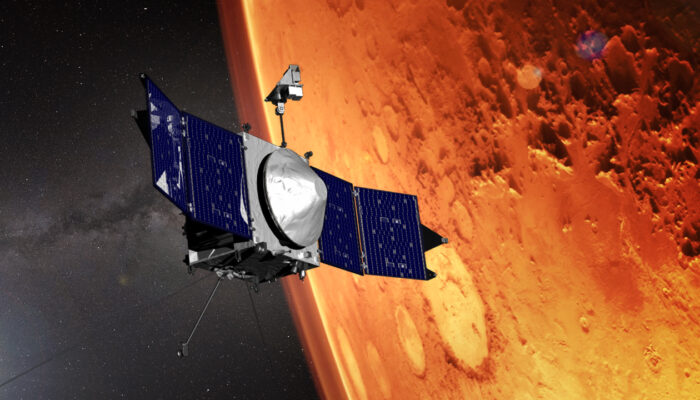
The Solar-Terrestrial Relations Observatory (STEREO) – an artist’s impression. Source: NASA/JHU APL.

How do you image the impact of a solar disturbance on a planet and what can images like these tell us about near-Earth solar wind conditions?

Although STEREO was launched during an exceptionally quiet period of solar activity, major solar storms were occasionally launched from the Sun into interplanetary space, transporting large clouds of electrons. Since the STEREO HIs were imaging solar wind conditions near the Earth during the start of the mission, we could image several solar storms impacting our planet for the first time. The Earth is so small in these images that all we see is the storm passing over the location of the Earth, not the local deformation that occurs as the storm interacts with the Earth’s magnetic field. During the first three years of the STEREO mission, the orbital position of the spacecraft was perfect to determine the arrival time of a storm at Earth. This new instrumentation has become so useful that future space missions, particularly those dedicated to predicting near-Earth space weather, will have these imagers on-board.

You’ve had to master a huge array of techniques to complete work on solar energetic particles – what advice would you give other young scientists who need to balance their workload with taking time to learn new skills?

My advice is move out of your comfort zone and DARE! Don’t be afraid to plunge into new datasets.  Ask the simplest questions first, I’m always surprised to see how little is generally known in many areas.

During the exercise of research, I often find that many of my initial ideas or guesses, even though constructed on logical sequences of arguments turn out to be wrong after close inspection and a thorough test against a wide range of datasets. Nature is always ready to surprise us! Therefore, I tend to avoid areas of science where theories are too far ahead of observational or experimental capabilities – they tend to be stagnating areas of science.

When you start working with datasets that you are not yet familiar with, approach the most productive and creative scientists in your area of research. They never stopped being children and are usually genuinely interested in giving some advice to young scientists thereby often saving you a lot of time.

The Solar-Terrestrial Relations Observatory (STEREO) – an artist’s impression. Source: NASA.

Finally, what are your plans for the future?

I will carry on my research in heliospheric physics to prepare for the future major space missions: ESA’s Solar Orbiter and NASA’s Solar Probe+. Solar Probe +, ‘a NASA mission to touch the Sun’, will go the closest a probe has ever been to the Sun, right where the solar wind is accelerated (9 solar radii). This is very exciting; we will collect the data that is critical to understanding how the solar wind and energetic particles are accelerated to high energies.

ESA’s Solar Orbiter will return to the very inner heliosphere (0.3AU) and will image the solar surface and the solar corona from outside the ecliptic plane. This will provide critical information to answer a wide range of fundamental questions: where are solar magnetic fields generated? How are these magnetic fields expelled? How is energy deposited in the coronal plasma? We are also pushing for a new space mission located, like the STEREO mission, outside the Sun-Earth line to image transients propagating from the Sun to the Earth. Unlike STEREO the mission will remain at a fixed distance from the Earth and will be used by space-weather centres to accurately predict the onset and perhaps the magnitude of geomagnetic storms.

If you’d like to suggest a scientist for an interview, please contact Sara Mynott.

Ice on top of the world! Breakthroughs in mountain glacier research

3 May

Fresh from leading a team of UK geophysicists on a two-week campaign of seismic investigations in northern Sweden, Dr Adam Booth of Swansea University provides for us his second report from the 2012 General Assembly floor. His first post explored subglacial environments of ice sheets and glaciers. 

Hi again from Vienna, and Day 3 of the EGU’s General Assembly.  Hope you’re enjoying reading the blogs!

My previous post focussed on the deep, damp world of the subglacial environment; today, I’m gaining considerable altitude and talking to Dr Lindsey Nicholson (University of Innsbruck) about her growing interest in debris-covered mountain glaciers, and learning from some of the researchers in her debris-dedicated session.

In my own experiences of Arctic geophysics, glaciers are usually pristine: covered by fresh snow, and easily traversed by snowshoe, ski or snowmobile.  As ever, though, variety is the spice of life and there are some glaciers that are altogether…rockier.  In fact, many mountain glaciers lurk beneath a mantle of fallen rocks and this provides them with a uniquely complex set of characteristics.  A geophysical survey on a glacier that’s strewn with rocks strikes me as a particularly taxing problem – it’s difficult to tow a radar system across a boulder field, or to install a seismic line in solid rock – so I was interested to learn more about alternate methods of studying debris-covered glaciers.

Dr Lindsey Nicholson (right) shares a joke with a colleague at Wednesday evening’s “Debris-covered glaciers session”.

“There’s a growing interest in debris-covered glaciers,” Lindsey tells me.  “In the last few years, they have really come to the fore since we’ve realised how little we know about them.”  The more I talk to Lindsey, the more I realise that debris-covered glaciers really are a law unto themselves.  In general, physical descriptions of ‘clean-ice’ glaciers, of their motion and the energy that is supplied to them, often work pretty well.  Unfortunately, give a glacier a debris-cover and it’s a whole different beast.  For example, an initial dusting of debris exacerbates glacier melt – the debris absorbs more solar radiation, warms up, and ends up delivering more heat to the glacier.  However, when that debris exceeds a certain critical thickness (e.g., after piling-up successive rockfalls), it acts as a sunscreen and glacier melting is reduced (the talk of Martin Juen of the Bavarian Academy of Sciences, Germany, was dedicated to understanding the controls on this).  Lindsey’s experience suggests that there might be a veritable mountain to climb:  “Our current understanding doesn’t capture the full complexity of the system.  The old processes need to be modified, adapted, or reinvented.”

A major boost in our understanding is provided by Pierre-Marie Lefeuvre, formerly an MSc student at the University of Sheffield (UK), now a PhD student at the University of Oslo (Norway).  In collaboration with Dr Felix Ng, Pierre-Marie has developed a computational method that offers new understandings of the coupling between debris-cover and glacier-flow model.  The model predicts that, as a debris-covered glacier starts to melt, the relative area of its debris cover becomes larger; as the glacier wastes away, previously-buried rockfalls become exposed and linger on the surface.  Differences in debris cover can even cause a glacier to split, with a lower section stranded from its higher-altitude counterpart.  Future predictive models will undoubtedly be indebted to the pioneering steps of Pierre-Marie’s work, and he advises that we keep an eye out for an imminent publication.

Adina Racoviteanu discusses her poster with Pierre-Marie Lefeuvre. (I promise it’s an unposed photo!)

But even seeing a debris-covered glacier can be problematic.  Normally, glaciologists would delineate clean-glacier ice using remotely-sensed satellite images: however, distinguishing a debris-covered glacier from – say – a debris-covered mountainside is understandably tricky.  Fortunately, Dr Adina Racoviteanu (post-doc, LGGE Grenoble, funded by CNES France) is something of a remote-sensing revolutionary.  In recent research she has developed algorithms that are able to predict whether surface debris cover is underlain by ice…or just more debris.  The image below shows the results of this method (recently published in the journal Sensors), in which the red areas clearly demarcate the extent of the debris-covered glacier.

Defining debris-cover… Adina Racoviteanu’s work allows debris-covered glaciers to be identified from satellite data. Ice is most-likely located beneath the bright-red areas.

Even more inspiring is that the next step in this research – classification of features based on their surface texture – is inspired by processes developed in medical science!  Textural data, derived from ASTER and Quickbird satellite images, are combined with surface topography and temperature records to define the edges of the debris-covered glacier.  This work, Adina tells me, will be a big step towards quantifying how much melt is occurring beneath a glacier’s debris cover.

My conversation with Lindsey now moves specifically towards Himalayan glaciers.  In addition to their current contribution to sea-level rise, changes to Himalayan glaciers are associated with other significant humanitarian effects.  On one hand, the glacier is a valuable resource, often representing the only resource of fresh water for an isolated Himalayan community.  On the other, pooled meltwater can catastrophically break out of confining debris layers, flooding villages and destroying valuable agricultural land – and such unstable terrain also deters investment in economic, local-scale hydraulic power plants.  However, a key difficulty in predicting the behaviour of Himalayan glaciers is the natural variability over an enormous geographical scale:  “East-west, north-south,” Lindsey says, “the Himalayas are completely different.  Accurately extrapolating observations across such wide areas is clearly problematic.”

During the session’s poster presentations, I happened across UNIS’s Professor Doug Benn.  “Five years ago,” he told me, “we had no idea of how mountain glaciers were changing.  Since then, we’ve really come on leaps and bounds.”   The vibrancy in the community really echoes his words.  I’m by no means a specialist in high-altitude glaciology, but I left the session enthused with the feeling that many more key breakthroughs are just around the corner.  There might be a mountain to climb, but I really think I’ve just met the people to climb it.

By Adam Booth, post-doc at Swansea University

Imaggeo on Mondays: Sky-high dancing lights

26 Dec

Sky high by Taro Nakai, distributed by EGU under a Creative Commons licence.

This photo, taken in early 2011 at Murphy Dome, a mountain in Fairbanks North Star Borough in the US state of Alaska, shows a beautiful natural phenomena known as aurora.

Auroras, also called northern lights in the Northern Hemisphere, are stunning light displays visible mainly at high latitudes. There, it is easier for energetic particles from the Earth’s magnetosphere and solar wind to follow the planet’s magnetic field lines and collide with atoms of gas in the atmosphere. These interactions release photons of different colours, depending on the gas the energetic particles interact with. The result? Awe-inspiring colourful curtains of light dancing in the skies.

The photographer, Taro Nakai, is a micrometeorologist at the International Arctic Research Center, University of Alaska Fairbanks. He took this shot for a beautiful time-lapse movie, available from his YouTube channel.

“Murphy Dome has an elevation of 776 meters, and since it is located in a cold subarctic area, the top of this mountain is so-called alpine tundra. Therefore, there are no tall trees and we can see the unobstructed view of the spectacular northern lights,” said Nakai.

Imaggeo is the online open access geosciences image repository of the European Geosciences Union. Every geoscientist who is an amateur photographer (but also other people) can submit their images to this repository. Being open access, it can be used by scientists for their presentations or publications as well as by the press. If you submit your images to imaggeo, you retain full rights of use, since they are licenced and distributed by EGU under a Creative Commons licence.

EGU General Assembly 2012 Call for Papers

9 Nov

Abstract submission for the EGU General Assembly 2012 (EGU2012) is now open. The General Assembly is being held from Sunday 22 Apr 2012 to Friday 27 Apr 2012 at the Austria Center Vienna, Austria.

You can browse through the Sessions online.

Each Session shows the link Abstract Submission. Using this link you are asked to log in to the Copernicus Office Meeting Organizer. You may submit the text of your contribution as plain text, LaTeX, or MS Word content. Please pay attention to the First Author Rule.

The deadline for the receipt of Abstracts is 17 January 2012. In case you would like to apply for support, please submit no later than 15 December 2011. Information about the financial support available can be found on the Support and Distinction part of the EGU GA 2012 website.

Further information about the EGU General Assembly 2012 on it’s webpages. If you have any questions email the meeting organisers Copernicus.

Imaggeo on Mondays: Entangled

11 Jul

South auroral oval and polar rain simulated in laboratory using the Planeterrella experiment (J. Lilensten et al., UJF/CNRS, Grenoble, France, online). The Planeterrella was redesigned after K. Birkeland’s original terrella experiments, which in the 1900s helped him unveil the mechanisms at the origin of polar aurorae. A magnetised aluminium sphere is placed in a vacuum chamber. An electric current is then established between the sphere (anode) and the electrode at the top of the figure (cathode) producing emissions in the visible and UV ranges. Image by Cyril Simon Wedlund, distributed by EGU under a Creative Commons License.

Imaggeo is the online open access geosciences image repository of the European Geosciences Union. Every geoscientist who is an amateur photographer (but also other people) can submit their images to this repository. Being open access, it can be used by scientists for their presentations or publications as well as by the press. If you submit your images to imaggeo, you retain full rights of use, since they are licenced and distributed by EGU under a Creative Commons licence.

Call for Sessions for EGU General Assembly 2012

8 Jul

The public call for sessions for the European Geosciences Union General Assembly 2012 has been issued. The EGU GA 2012 will be held at the Austria Center Vienna (ACV) from 22 April to 27 April 2012. The details are below, the web page to visit to submit sessions is Call for Sessions page of the EGU General Assembly 2012 website.

We hereby invite you, from now until 16 Sep 2011, to take an active part in organizing the scientific programme of the conference.

Please suggest (i) new sessions with conveners and description and (ii) modifications to the skeleton programme sessions. Explore the Programme Groups (PGs) on the left hand side, when making suggestions. Study those sessions that already exist and put your proposal into the PG that is most closely aligned with the proposed session’s subject area.

If the subject area of your proposal is strongly aligned with two or more PGs, co-organization is possible and encouraged between PGs. Only put your session proposal into one PG, and you will be able to indicate PGs that you believe should be approached for co-organization.

If you have questions about the appropriateness of a specific session topic, please contact the Officers for the specific EGU2012 Programme Group. To suggest Union Symposia, Great Debates, Townhall Meetings or Short Courses, please contact the Programme Committee Chair (Gert-Jan Reichart).

In case any questions arise, please contact EGU2012 at Copernicus.

Geosciences and Web 2.0 at EGU GA 2010

5 May

The Educational and Outreach Symposia at the European Geosciences Union General Assembly 2010 cover a variety of topics. Several include examples of best practice. Virtual conferences and observatories are covered in ST6/EOS9 as described in the below guest blog from Sini Merikallio of the Finnish Meteorological Institute.

Thursday in Room 29, 10:30-12:00 in ST6/EOS9 Best practices in Education and Outreach contains a talk from a distinguished journalist who will be sharing his experience with scientists. Other talks include virtual conferences and online data repositories.

Tähdet ja Avaruus (‘Stars and Space’) is the most popular astro-magazine in the Nordic countries as measured by the number of subscribers. The Editor in Chief of the magazine, Marko Pekkola, has revolutionized the magazine and during his era the relative amount of astronomy hobbyists in the general public in Finland has increased to
become one of the world’s highest. Mr. Pekkola is invited to the session to reveal how this has been accomplished. The magazine has also witnessed numerous cases of both good and bad science popularizing, and Mr. Pekkola will also be sharing his educative
summary of these experiences.

Virtual conferences and remote accessing and representation of data are currently becoming crucial in the scientific community as well as among the general public. Dr. Victoria Pearson will talk about virtual conferencing techniques in enhancing remote public engagement. A special talk about building of a virtual observatory is also arranged: Dr. Mikko Syrjäsuo will present GAIA: an open access online virtual
observatory for accessing auroral data. Thanks to GAIA, anyone will be able to easily access high-quality data in order to work from their offices, home couches or from the classroom.


Follow

Get every new post on this blog delivered to your Inbox.

Join other followers: